A little reminder that there are many ways to be and to contribute, and while attending in lessons may be hard for students with attention difficulties, they have so many other strengths which come into play when the environment suits them better.


Dyslexia Support and Assessment in Hampshire
Advice and strategies to compensate for Specific Learning Difficulties and information about diagnostic assessment
A little reminder that there are many ways to be and to contribute, and while attending in lessons may be hard for students with attention difficulties, they have so many other strengths which come into play when the environment suits them better.
Did you know that Duolingo, the globally popular language learning App, has recently launched a Maths course for children?
Duolingo works beautifully to maintain attention when learning, with its short, colourful lessons and all sort of encouragements and rewards for small steps to success. Great for students with processing difficulties who need lots of repetition and something very engaging to help them learn.
Being able to practice maths daily for 5 or 10 minutes in this way could be a perfect way to encourage children on the path to success. It is easy to jump initial lessons and start where existing knowledge tails off, but don‘t go too far ahead, as opportunities for success are just what our learners with SpLDs need to boost their confidence.


Signs of Slow Procesing

Strategies for Slow Processing
Talking to your children, along with reading to them, is the best thing you can do to develop their language skills, which are a huge part of how they can develop reading comprehension skills themselves.
As well as developing vocabulary, talking to your children develops their understanding of syntax (how sentences are built), context (what words may mean in different situations) and inference (what something means, even if it is not explained explicitly).

Discover animal artworks and fun activities to use in your classroom. From under the sea to rainforests, animals are in lots of different kinds of art.
— Read on www.tate.org.uk/art/teaching-resource/animals-art
(N.b. Look at the main page “How do Teachers Support Dyslexic Students at School for broader information on school support.)
There a few effective ways teachers can adapt delivery of lessons in small ways to help dyslexic students access learning more easily.
N.b. Because these adaptations address slow processing, weak memory or concentration and gaps in learning caused by such processing difficulties, they are also good ways to support students with other Specific Learning Difficulties too.
1) Leave short gaps or pauses between points when speaking: this can help those with slow processing keep up. Sometimes, students process what they hear a fraction slower than others, and a second or two pause regularly can make all the difference. Maths in particular, in which it is difficult for students to find their own “hooks” back into what they missed, is where speed of delivery of new input can be the key to understanding, especially at college, when volume and intensity of work increases.
2) Try to provide more time and more repetitions to embed understanding for students with slow processing or weak memory, before moving on. At primary school, some students may be on the verge of learning a phonic rule, then the class moves on to the next rule just before this is fully secure, and the knowledge can be lost. The same could go for maths concepts in year 7. Finding a way not to move on too fast may be all some students need.
3) Provide visual prompts or reminders of instructions on the white-board, to help those with weak memory retain information more easily.
4) Consider classroom seating position. Sometimes, asking the student how they need to work is required to address attention issues.
5) Some dyslexic students will struggle more than others with reading aloud and enforced reading aloud can have a greater impact on confidence and motivation in the classroom than might be imagined. Teachers can think about when and how to ask such students to read in front of the class.
6) If handouts can be made available or presentations/ lessons are online, it is helpful to allow students who process slowly, to produce class notes in a different way. Trying to write everything down may result in it not being taken in. Better to suggest they highlight key words and focus more on understanding what they are hearing.
7) Slow processing or weak memory may mean that students have not retained information about grammar and sentence structure, as well as spellings. Sometimes a recap on complex sentence structure and how to build a paragraph in particular can help secondary students realise that there is a system they can follow.
8) Similarly, some dyslexic students may not have developed their language skills as much as their peers have, as a result of not reading very much for pleasure. Take time occasionally to practice or model complex language verbally, to help them learn how to write effectively. LSAs working 1-2-1 with students who struggle a lot with writing may find this particularly helpful.
9) Dyslexic students who do not reread often may also struggle to read or spell complicated vocabulary as they progress through secondary school, limiting their ability to access the curriculum or demonstrate their understanding. Provide topic vocabulary lists or help students build their own can make a big difference.
10) When teaching students how to plan written work, show how to ask themselves questions to come up with ideas. It can be as simple as practising the five types of questions beginning with “W”: Who, What,Where, When,Why? This starts an internal dialogue and increases confidence that there is not just one right way of doing it. It particularly helps students who struggle to think of how to start.
These are all simple ways that can help students with dyslexia thrive in class. If some of these suit your child, you may want to mention them at parents evening with subject teachers.
(N.b. Look at the main page (How do Teachers Support Dyslexic Students at School for broader information on teacher support.)
Schools usually have their own literacy intervention programmes and resources. But sometimes, being a little bit creative with literacy lessons or follow up by making your own word and sentence cards and using them in game format can save money, be quicker to arrange and help those dyslexic students who are struggling the most, or who have become reluctant to participate, to gain confidence and make progress. Making your own cards and turning them into your own games is very flexible, quick and easy, and motivating, because it brings more fun.

Many schools will have expert dyslexia tutors on their staff, or support staff who have lots of experience at making or using resources. They might not need this page. But if in your school you are short of funds to buy resources, these ideas could be helpful and could spark many more ideas. The games suggested are intended as reinforcement activities to secure knowledge on whatever phonic lesson you are trying to deliver. They are not intended as the phonic lesson in itself.
1) Word Cards and Sentence Cards – how to use them.

An important principle when teaching phonics or spelling rules, is always include an opportunity to apply the new rule in full sentences. This could be reading sentences or writing words within a sentence. Most of these games work best for reading.
Word cards should only be used for phonic rules being taught and already taught, and they should be taught in the right order, to ensure the student is always a able to succeed.
Having said that, all that is required is for word/sentence cards to be cut and written or typed and printed and for them to be incorporated into a game.
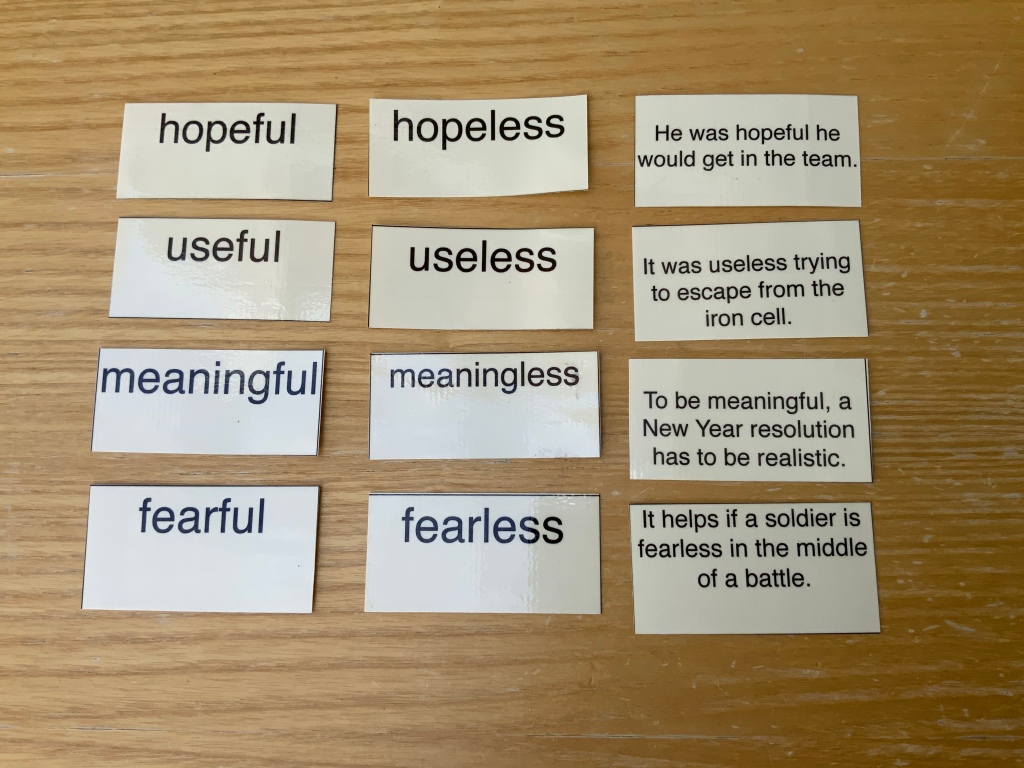
Games include:
1) Snap and Pairs: i) for rhyming words; ii) for the exact same word (say when you are learning words with the same prefix but different core and are practising noticing different parts of words); iii) for opposites (say with opposing suffixes).
2) Bingo – two or more sheets with target words on them and cards with those same words, drawn from a pile. First to complete their sheet wins. Students have to say the words, or use the word in a sentence when they take their turn.
3) Board games – a card with the target word or sentence has to be read out each turn.

(If spelling is required, the support teacher can read out the target word and the student spells it, each go. If something different from phonic rules is the focus, revision cards with a question on the front and answer on the back can be used instead of word or sentence cards)
4) Dice games: you can buy cheap foam dice and put initial letters or consonant blends on one of the dice, and the rime (the ending bit of the word) on another dice, and when the two dice are thrown, you can try to make a word.
5) Jigsaws These are simply a motivational element. Whatever work the student is set, if they would otherwise struggle with motivation, the support teacher could create simple jigsaws and give the student a piece each time they complete one of their targets. It might sound too good to be true but even the most reluctant learners can be motivated by this, if the jigsaw relates to a strong interest. It can work up to year 6 or even year 7).

All you need to do, is be sure of the student’s interest and collect colour magazine pictures of this. It could be football, cars, Volkswagen Beetles, maps. Laminate the picture and cut it into six, eight, nine, ten or twelve sections,depending on the age of student and shape of picture. Then pile them up and they take a piece each time they complete something. With car enthusiasts, students can try to guess which make or model after only a few pieces.

(N.b. Look at the main page “Supporting Dyslexic Students at Home“ for broader information. To support parents)
There are many phonics games available commercially but it is sometimes difficult to know which would suit your child and how you could use them without specialist knowledge. Phonics – learning the relationships between sounds and letters – has to be learned in order, from the most basic rules such as the sounds made by letters of the alphabet on their own or in simple three letter words, to how to use double consonants at the beginning and end of words, to how to make different vowel sounds by combining vowels, and so on. Unless you have attended a parent phonic programme by a dyslexia training provider (and these are great), you can only play phonic games at home with your child armed with knowledge about exactly which phonic rule or rules they are working on that week. The commercial games can be useful, but you need to know which cards or dice or whatever other resources are involved to use and how.
If your child’s teacher does tell you each week what sounds they are working on, you could produce your own simple cards for words using the appropriate sounds and make them into a fun game.
1) ALPHABET ARC WORD BUILDING. This is useful for children who are stumbling at the first steps of phonic learning. It will reinforce knowledge of basic letter sound links which will support all future phonics learning at school.

i) You need letters of the alphabet, wood or plastic or on cards. The first step is practising laying them out in an arc on the floor in the correct order, saying the names of the letters. This stage could be a repeated game over several days or weeks, depending on progress. You can teach your child the alphabet song if you can remember it. The more times it is sung, the more automatic it becomes in memory. That will help your child remember the order of letters in later school life, to help them use a dictionary for example.
ii) The next step is to make clear that each letter has a basic “sound” as well as a name. The letter “a” is pronounced as in apple, “b” as in bat, c as in cat, and so on. Practising and talking about the sounds made by all the letters would be done over days or weeks too. It is important to only cover one sound per letter at this stage. It would be confusing to explain that vowels have two sounds, and then two vowels together can make all sorts of sounds.
iii) Once letter names and letter sounds are learned, you can start to play with three letters together to make simple words. It is important to stick to words that start and end with a consonant and have a vowel in the middle. These are called CVC words (Consonant vowel Consonant words). You may need to explain that the vowels are a,e,i,o,u and consonants are everything else, and every word has to have a vowel.

So to start, let your child choose a vowel to draw down from the arc and put in the middle below it. Then they can choose a consonant to go at the end. Try to encourage them to use one which can make lots of words (d, g, t, p for example). Practise saying the sound those two letters make together. Then your child can draw down, one by one, other consonants to put at the front, to make lots of words. All the words will rhyme of course. You can play this using different vowels and different end consonants as much as you want.
This, if you can be sure you are playing it according to the rules above, is one of the most effective pre-literacy skill games you can play with a child struggling at the outset with phonics.
2) PAIRS/ SNAP By making two (or four) cards for each target word, you can make a snap or pairs game. (Pairs can be done with cards face up or face down, in which case it also becomes a memory game.) You can also make a snap game in which a pair would be two words which rhyme (e.g. “cat” and “mat”). You can even create “cards” as footprints to put together and then walk along. “Twinkl” is a website with all sorts of printable resources like that to use to get creative.


If your child is at the very beginning of learning about rhyme, you could make a pairs or snap game using only picture cards – of a cat, hat, bat; man, pan, fan; map, tap, cap, for example – and let your child discover rhyme that way. Or you could lay all these cards out and let him or her work out how the cards could be put into groups, learning by discovery about rhyme. It may take a while to get there, but once they have, they will not forget it!
Once they’ve got it, you can encourage them going around the house or wherever they are, saying out loud rhymes for names of the things they see in front of them. The rhymes there come up with don’t have to be real words, they just have to rhyme. Playing this over and over early on reinforces a vital pre-literacy skill.
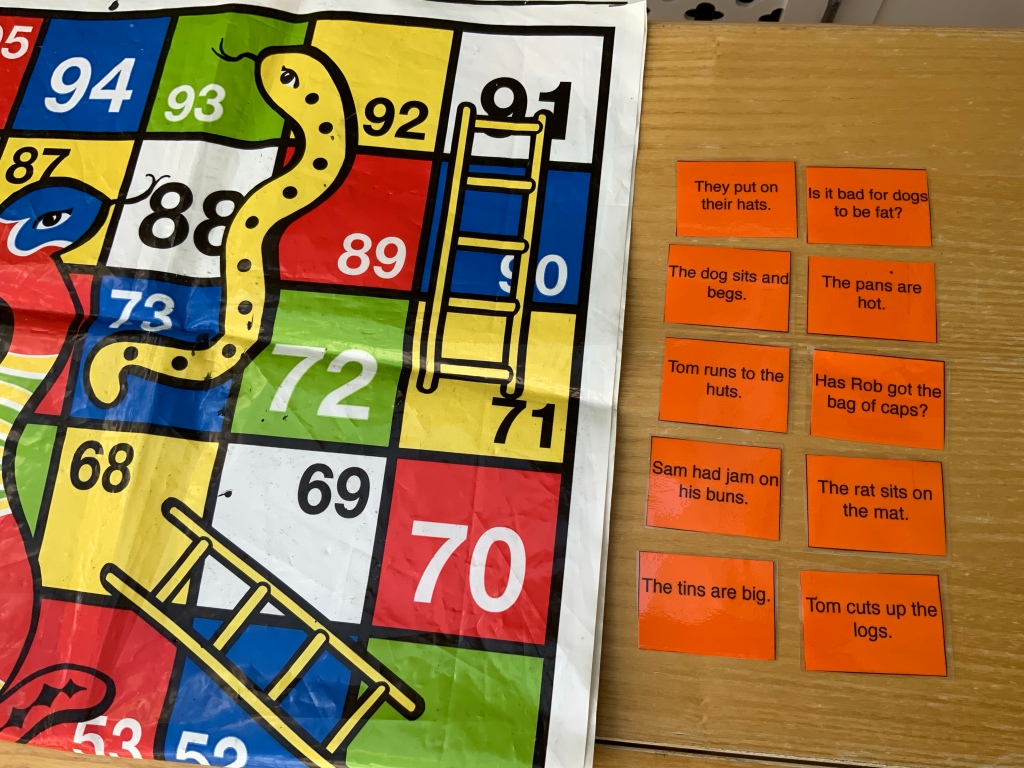
3) SNAKES & LADDERS. Just playing snakes and ladders is a great opportunity in itself for learning. Sometimes, weak short term memory can make it hard to make number skills automatic. By using two dice and teaching your child to tap along the squares of the board in twos, they are practicing their two times table.
Children are motivated by reward and happier to practice skills if that is linked to fun. So you could write up a set of word cards, or sentences using only words they know, focused on the words of the week, and ask them to pick up a card and read it out every time they take their go. It really works!
4) FISHING GAME. You can make a “fishing rod” using a pencil, string and a magnet, and cut out simple fish shaped cards with key words for learning that week. Put a paper clip on each fish. You can draw a pond on a piece of paper in which all the fish can swim. Then simply take turns trying to pick up the fish, reading out the word each go. It is amazing how much more motivating this is. It is also more memorable, and we know that dyslexic children learn in a multi-sensory way and when learning is fun and more memorable. You can make fish with simple sentences too. It is always more effective to allow your child to practice new words in the context of a sentence when they learn them. But be careful not to include words more difficult than those they have already covered.

5) KIMS GAME. This is a memory game. You get a tray and put ten different objects on it. (Or fewer if necessary to begin with. Or more later!). Choose objects of different sizes, shapes and colours and with different uses. Then your child, or any children with you (it can be played with different ages together) get a minute to look at the objects and try to put them in their memory. Then you cover the tray with a tea towel and leave it a minute, before asking the children how many objects they can remember. Playing this often will give them a chance to work out memory strategies, such as remembering initial letters, colours, what the object is used for. Discussing this with your child will reinforce the learning. Then you take the tea towel off and see who has won! Another sample memory game is “My Grandmother went to Market and she came home with …”

6) TELLING STORIES VERBALLY. Some dyslexic children find it difficult to think of and organise ideas for writing. Practising thinking of ideas, sequencing them and expressing them verbally, in a fun way, is the best way to develop the language skills they can then start using in writing. You can’t write what you don’t know how to say.
You can cut out colourful pictures from calendars or magazines and start a conversation about what is going on in the picture. Ask questions about what is happening and why, what a child or animal in the picture might be thinking, what might happen next. That is the beginning of learning how to use language to question what is seen or heard (or, later, what is known), to make a story or an argument.

 Dyslexia Support and Assessment in Hampshire